

Las Vegas is the brightest city on Earth from space, a glow visible to astronauts and satellites alike. That distinction has always felt like a point of pride. Lately it has started to feel like a problem worth solving, and the solution is reshaping something as ordinary as how a homeowner lights a backyard patio.
A statewide effort to reclaim Nevada’s night sky has been gathering momentum, and while it started with parks and small towns, its logic is filtering down to residential outdoor lighting in the valley.
The shift is not about using less light. It is about using light more deliberately, and for a patio that turns out to produce a better-looking, more comfortable space almost by accident.
What Nevada Is Actually Doing About Light
In 2021, the state tasked its Division of Outdoor Recreation with building a dark-sky certification program under Senate Bill 52, and the Nevada Starry Skies Certification Program launched in October 2024 as a first-of-its-kind statewide effort.
The program lets communities, HOAs, and businesses earn recognition by adopting lighting policies that cut light pollution. Las Vegas-area communities have been early movers, with Pahrump already operating under a dark-sky ordinance and Boulder City retrofitting its municipal lighting toward dark-sky standards.
The waste numbers behind the push are striking. DarkSky International estimates that 30 percent of all outdoor lighting in the United States is wasted, amounting to billions of dollars in energy and millions of tons of carbon every year.
The core idea is simple: light that spills sideways and upward into the sky is light that was paid for and never used. Aiming it where it is needed instead of everywhere is the whole game.
What “Dark-Sky Friendly” Means for a Backyard
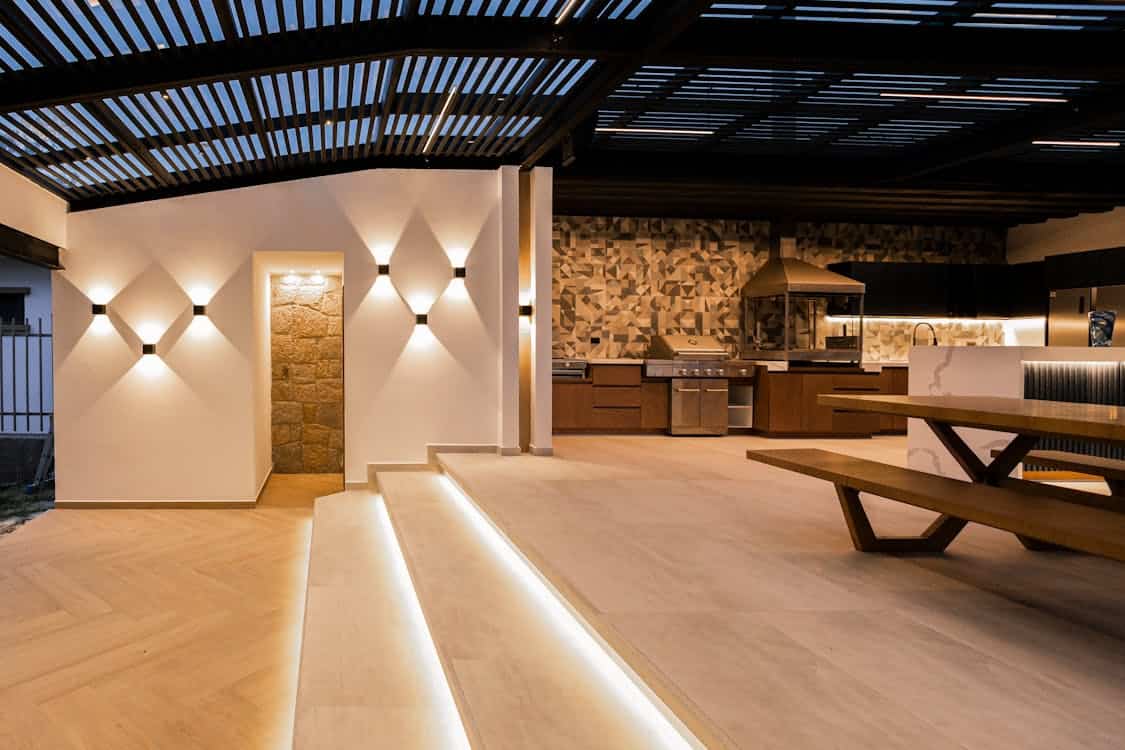 For a homeowner, dark-sky principles are not a restriction so much as a design discipline. The guidance comes down to a few practical habits that happen to make a patio look better.
The first is shielding. Fixtures that direct light downward, where people actually need it, rather than out and up, eliminate glare and the harsh hot spots that make a patio feel like a parking lot.
The second is warmer color temperature. Softer, warmer light reads as inviting and lounge-like, while the cold blue-white of an unshielded floodlight is exactly the kind of spill the dark-sky movement targets.
The third is only lighting what matters. Path lights low to the ground, downward fixtures over a dining table, and shielded sconces along a wall deliver usable light without blasting the whole yard, which is both more efficient and more atmospheric.
On a covered patio, this is easy to execute. Recessed downlights set into the underside of an aluminum cover throw light exactly where it is wanted, and the solid surface above keeps it from leaking upward in the first place.
Why This Fits the Las Vegas Backyard Specifically
There is a local irony worth naming. The same desert that bakes the valley by day offers some of the most spectacular night skies in the country just beyond the city’s glow, and residents increasingly want a piece of that back.
A patio lit with shielded, downward, warm fixtures lets a homeowner actually see the stars from their own backyard, instead of washing them out with overspill that bounces off every surface.
It also dovetails with the way valley patios are already trending toward solid covers and defined outdoor rooms. A structure overhead is the natural anchor for well-aimed, glare-free lighting, and it makes the dark-sky approach the path of least resistance rather than a sacrifice.
The state is not going to send an inspector to a backyard. But the direction is clear, and homeowners designing a patio now are increasingly choosing the shielded, intentional approach because it simply produces a nicer space.
Las Vegas may stay the brightest dot on the satellite map for a long while. In individual backyards, though, a quieter and more flattering kind of lighting is winning, and the night sky is the better for it.